

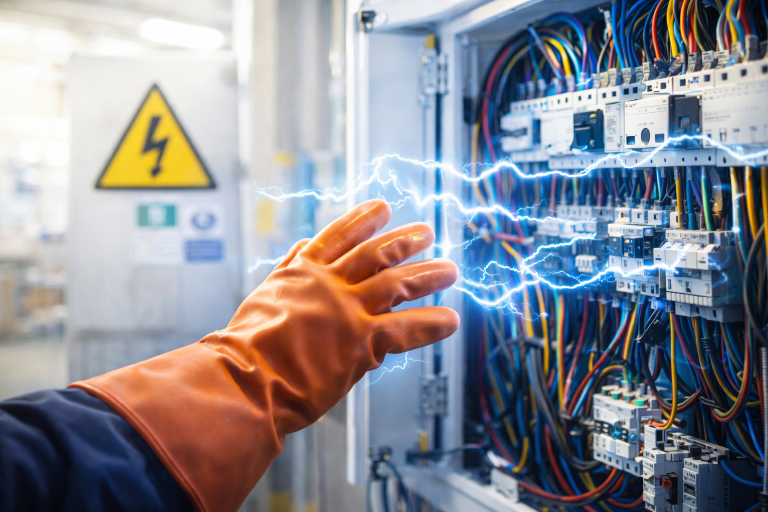
Electrical risk is one of the most insidious hazards in the workplace. It may seem remote — something that concerns only electricians or those working in particular industrial settings. Yet the reality is different: every organisation has electrical installations, every worker may come into contact with energised equipment, and a mistake or a moment of inattention can have extremely serious consequences.
Electrical accidents are often fatal or result in permanent harm. For this reason, Italian legislation, through Legislative Decree 81/2008 and the CEI technical standards, requires employers to assess electrical risk and adopt adequate preventive measures. This is not merely a matter of installing compliant installations, but of properly managing activities that expose workers to this risk, particularly when live working is involved.
What is electrical risk and how does it manifest
Electrical risk arises from direct or indirect contact with live parts. Direct contact occurs when a person touches an exposed electrical conductor or a component that is normally live. Indirect contact occurs when a person touches a metallic enclosure that has become energised due to an installation fault, such as a machine casing.
The effects of electricity on the human body depend on the current intensity, the duration of contact, the path the current takes through the body and the environmental conditions. Even relatively low currents can be lethal if they pass through vital organs such as the heart. Consequences may be immediate — cardiac arrest or burns — or delayed, including neurological damage and internal injuries.
Electrical risk goes beyond direct contact, however. It also covers fire and explosion caused by electric arcs, overloads, short circuits or sparks in flammable atmospheres. These scenarios call for a specific assessment and dedicated preventive measures.
The electrical risk assessment must therefore consider not only fixed installations but also portable equipment, maintenance work, environmental conditions (humidity, conductive dusts) and the competence of workers who operate on or near electrical installations.
Electrical risk assessment: regulatory obligations and methodology
Every employer must assess electrical risk, as required by Article 80 of Legislative Decree 81/2008. This is not optional: the assessment must be carried out, documented in the Risk Assessment Document (DVR) and updated whenever working conditions or installations change.
The assessment starts with hazard identification. Where are the electrical installations? What equipment is in use? Who works on or near live parts? What are the environmental conditions? The assessor then analyses the possible modes of contact — direct, indirect or electric arc — and estimates both the likelihood of occurrence and the severity of consequences.
The key technical standards are CEI 11-27 for work on electrical installations and CEI EN 50110 for the operation of electrical installations. They set out precise guidelines on how to assess risks, what competencies workers need and what procedures to follow for each type of intervention.
A critical aspect of the assessment is the distinction between live working, work in the proximity of live parts and work with
the installation de-energised. Each situation demands different measures and specific competencies. There is no room for improvisation: detailed planning is essential, with written procedures and adequate training for everyone involved.
The assessment must also address the PPE needed to protect workers: insulating gloves, helmets, face shields, flame-retardant clothing and safety footwear. Each item must be selected according to the voltage level and type of work, and must be tested periodically to confirm its effectiveness.
PPE for electrical risk: how to select and when to use them
Personal Protective Equipment against electrical risk is essential but not sufficient on its own. PPE should always be treated as the last line of defence, after all practicable preventive measures at the level of work organisation and collective protection have been put in place.
Insulating gloves are the most common PPE for those working on electrical installations. They must be classified by voltage rating (class 00, 0, 1, 2, 3, 4) and must be intact, with no holes or cracks. Before each use they must be visually inspected and periodically subjected to electrical testing. A damaged glove provides no protection and can create a false sense of security.
Arc flash protective clothing is mandatory for live work or work near high-voltage live parts. Electric arcs generate extremely high temperatures in fractions of a second, causing very severe burns. The clothing must be certified to standard CEI EN 61482 and must cover the entire body, including hood, gloves and footwear.
Other essential PPE includes dielectric helmets, protective face shields against electric arcs, insulating footwear and respiratory protective devices for work in confined spaces with electrical risk. Every item must be compatible with the others: an insulating glove is useless if the rest of the clothing does not provide adequate protection.
Supplying PPE alone is not enough, however. Workers must be trained in correct use, maintenance, protection limits and when wearing PPE is mandatory. The employer must also verify that PPE is actually worn, because failure to provide or use adequate PPE constitutes grounds for criminal liability in the event of an accident.
Live working: CEI 11-27 standard and safety requirements
Live working means the operator deliberately contacts live parts or approaches them closer than the safety thresholds. These are high-risk activities that require specific competencies, rigorous procedures and formal authorisation.
Standard CEI 11-27 defines precisely what constitutes live working, what qualifications operators need and what procedures to follow for each type of intervention.
Before any live work begins, a risk assessment specific to the intervention is required. It must be verified that it is not possible to work with the installation de-energised — the first option is always to de-energise — that the operators hold the necessary competencies, that the PPE is adequate and that environmental conditions allow work to proceed safely.
A supervisor must be present throughout live working to oversee operations, verify compliance with procedures and be ready to intervene in an emergency. This is not a nominal role: the supervisor must have thorough knowledge of the risks and the authority to stop work if conditions become unsafe.
PES PAV training for electrical work: who needs it and what it involves
Training for electrical work is not optional. Standard CEI 11-27 distinguishes three qualification levels, each with different competencies and responsibilities.
The Qualified Person (PES) has in-depth technical knowledge and practical experience that enable them to analyse electrical risks, identify preventive measures and organise work safely. The PES authorises work, prepares work plans and supervises the most complex activities.
The Instructed Person (PAV) has sufficient training to recognise electrical risks and apply the preventive measures specified by the PES. The PAV may work under PES supervision but may not authorise interventions or work independently on complex installations.
The Qualified Person for live working (PEI) is qualified to carry out live work. Beyond the competencies of the PES, the PEI has received specific training in live working, demonstrated practical skills and obtained a certificate of competence that must be renewed periodically.
The training comprises a theoretical and a practical component, and its duration varies by qualification level. This is not a course that can be completed in a few hours: it takes time to build solid competencies.
Training does not end with the initial course. Periodic refresher training is essential, because standards change, technologies evolve and competencies must be kept up to date.
Electrical first aid: what to do in the event of an accident
Electrical accidents demand immediate and competent intervention. Every second counts, and knowing what to do can mean the difference between life and death.
The first rule is to secure the scene: do not approach the victim until you are certain they are no longer in contact with the electrical source. If possible, disconnect the power supply. If not, move the victim away using insulating materials — never with bare hands. Only once the hazard has been eliminated can first aid begin.
If the victim is unconscious and not breathing, start cardiopulmonary resuscitation (CPR) immediately. Electrical accidents can cause cardiac arrest even at relatively low currents, and CPR can save lives while emergency services are on their way. For this reason, all workers who operate on electrical installations should be trained in first aid and resuscitation.
For burns, do not apply ice or ointments. Cover the wounds with sterile dressings and call the emergency services immediately. Electrical burns are often deeper than they appear on the surface, because the current damages internal tissues.
Even if the victim seems well after an electric shock, they must always be taken to hospital for examination. The effects of electricity can appear hours after the accident, with cardiac or neurological damage that is not immediately evident.
Companies that manage electrical risk must keep adequate first aid supplies, trained personnel and clear emergency procedures in place. In the event of an accident, every minute spent working out what to do can have irreversible consequences.